PETALING JAYA, May 22 — Opposition leader and Perikatan Nasional (PN) deputy chairman Hamzah Zainudin has unveiled a bold vision for Malaysia’s future, proposing a “new national consensus” to overcome political divisions and foster inclusive growth and compassionate governance.
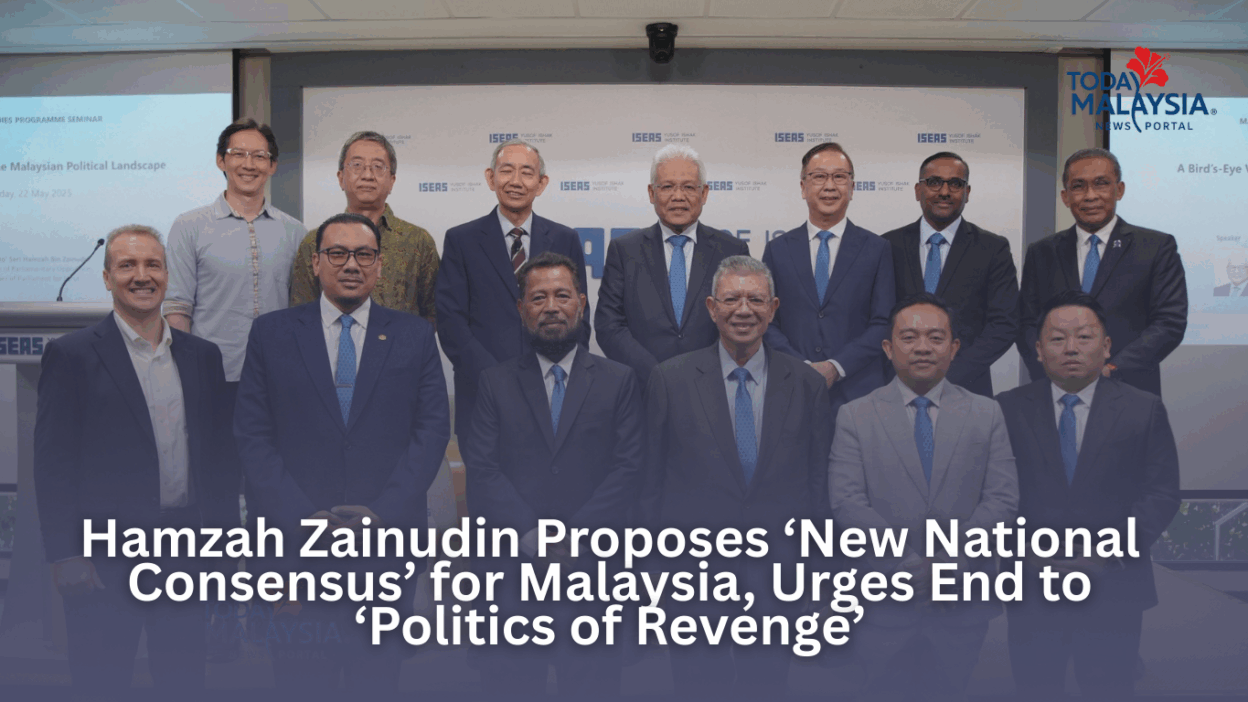
In a keynote address at the ISEAS–Yusof Ishak Institute in Singapore, Hamzah said the proposed consensus must transcend race, religion, and regional boundaries, uniting all segments of Malaysian society — from the political class to civil society and the rakyat.
“Malaysia must move past the age of political survivalism. We must reject the politics of revenge and rekindle the spirit of shared nationhood,” Hamzah said.
He outlined the vision based on three core pillars: a common goal, shared prosperity, and compassionate governance.
On shared prosperity, Hamzah called for a redefinition of national development goals to ensure no community is left behind.
“We cannot afford a Malaysia where the colour of your skin, or your postal code, determines the quality of your life.”
As for compassionate governance, he stressed the importance of humanity, dignity, and a people-centric approach, urging for citizens to be treated as partners in nation-building rather than as burdens.
PN’s Governance Track Record
Touching on PN’s time in government, Hamzah defended the coalition’s leadership following the collapse of the Pakatan Harapan (PH) government in early 2020. He cited internal ideological rifts between PH component parties — Bersatu, PKR, and DAP — as the main reason for its downfall.
“It also proved the deeper dysfunction within PH: the absence of a working consensus due to fundamental and ideological differences — one that was bound to collapse from the start. As they say, oil and water don’t mix.”
Hamzah credited PN’s leadership for steering Malaysia through the COVID-19 pandemic, highlighting that the economy rebounded strongly under its stewardship.
“By 2022, the country recorded a remarkable GDP growth of 8.7% — the highest in ASEAN. Unemployment fell from 5.3% in May 2020 to 3.6% by the end of 2022.”
Decision to Decline Unity Government
Hamzah also revealed that PN had been offered a chance to join forces with PH and Barisan Nasional (BN) to form a unity government after the 15th general election (GE15) in November 2022 — but chose to decline.
“PN chose to decline because such an arrangement would have been nothing more than another marriage of convenience, which was doomed to fail, just as PH 1.0 did in 2020.”
Strong Electoral Performance
Since GE15, Hamzah said PN has been consistently outperforming its rivals at the polls. In the 2023 state elections, the coalition won 146 out of 245 contested seats, retaining power in Perlis, Kedah, Kelantan, and Terengganu, while making significant gains in Penang, Selangor, and Negeri Sembilan.
“Whenever people call upon us, we are ready,” he affirmed.
Regional Engagement
The PN leader also met with Singapore’s Foreign Affairs Minister Vivian Balakrishnan during his visit, further underscoring PN’s commitment to regional diplomacy and cooperation.
Hamzah concluded by reiterating PN’s readiness to lead Malaysia into a new era grounded in unity, equity, and empathy — an approach he says is long overdue.