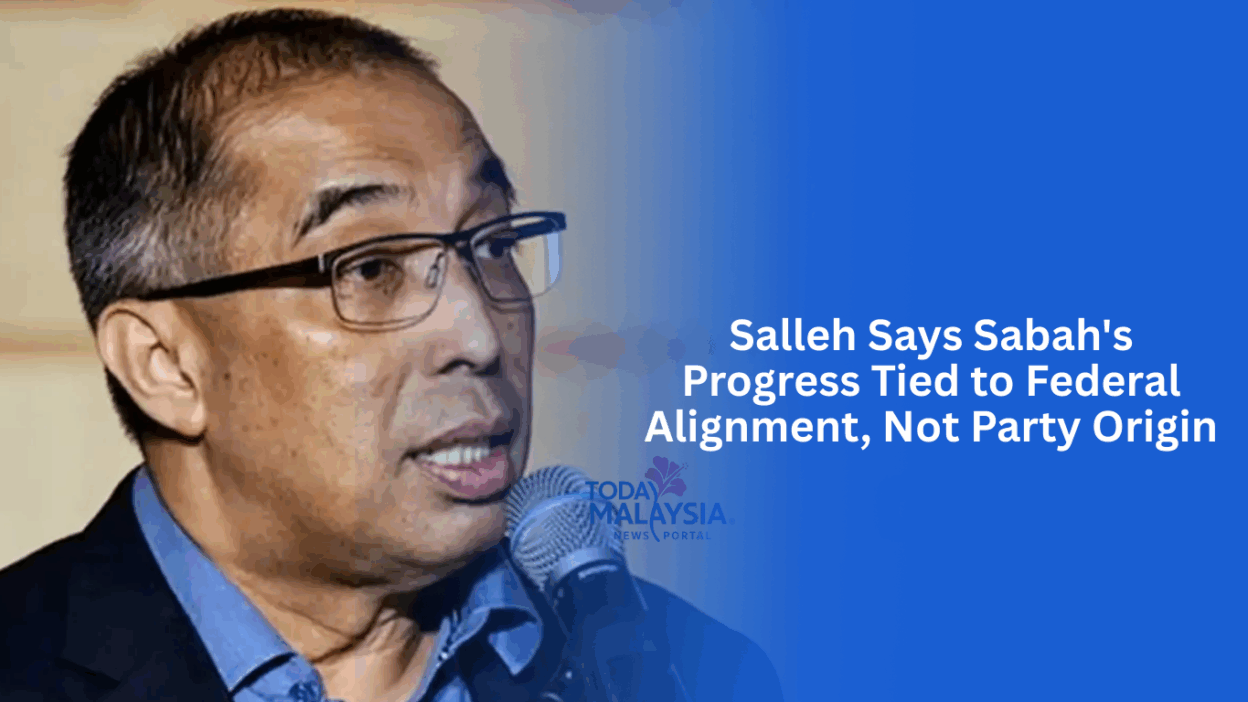
PETALING JAYA, May 25 — The debate over whether Sabah should rely on local or national political parties for its development is misplaced, says former Sabah Chief Minister Datuk Seri Salleh Said Keruak.
In a statement on Facebook, Salleh emphasised that since Malaysia’s formation in 1963, Sabah’s progress has consistently depended on its alignment with the federal government — regardless of whether local or national parties were in power.
“Since the formation of Malaysia in 1963, Sabah’s state government has almost always been aligned with the federal government, either through national coalitions like Perikatan and Barisan Nasional (BN), or through direct political cooperation,” he said.
Salleh highlighted that early state governments, such as Usno (1963–1975) and Berjaya (1976–1985), were local parties but still part of the national coalition, BN.
He noted that even after Parti Bersatu Sabah (PBS) defeated Berjaya in 1985, it eventually joined BN to maintain cooperation with the federal government.
However, a brief exception occurred in 1990 when PBS left BN to join the federal opposition coalition, Gagasan Rakyat, led by Tengku Razaleigh Hamzah and Semangat 46.
“This marked a rare period when Sabah was not aligned with the federal government, but it was short-lived and politically tense,” Salleh recalled.
He pointed out that BN’s return to power in Sabah in 1994 — following Umno’s entry into the state — ushered in 24 years of stability and development, closely linked to federal-state collaboration.
“When Sabah was under BN, many major development projects were carried out through close collaboration with the federal government,” he added.
Salleh also highlighted that following GE14 in 2018, when BN lost both the federal and state governments, Warisan — a local party — took over Sabah’s administration with the support of Pakatan Harapan under then Prime Minister Tun Dr Mahathir Mohamad.
This pattern continued after the 2020 state election when Gabungan Rakyat Sabah (GRS), comprising Bersatu, PBS, STAR, and SAPP, formed the government, again with cooperation from the federal coalition led by Perikatan Nasional.
“This again reflected a willingness to align with the federal government for stability,” Salleh said.
He concluded that party labels, whether local or national, are secondary to the core elements of effective leadership and intergovernmental collaboration.
“Collaboration between state and federal levels is not just an option — it is a necessity. What truly matters is effective leadership, political stability, and the ability to work together.”